
Ecopsychology
Foreign equivalent(s):
Écopsychologie (fr)

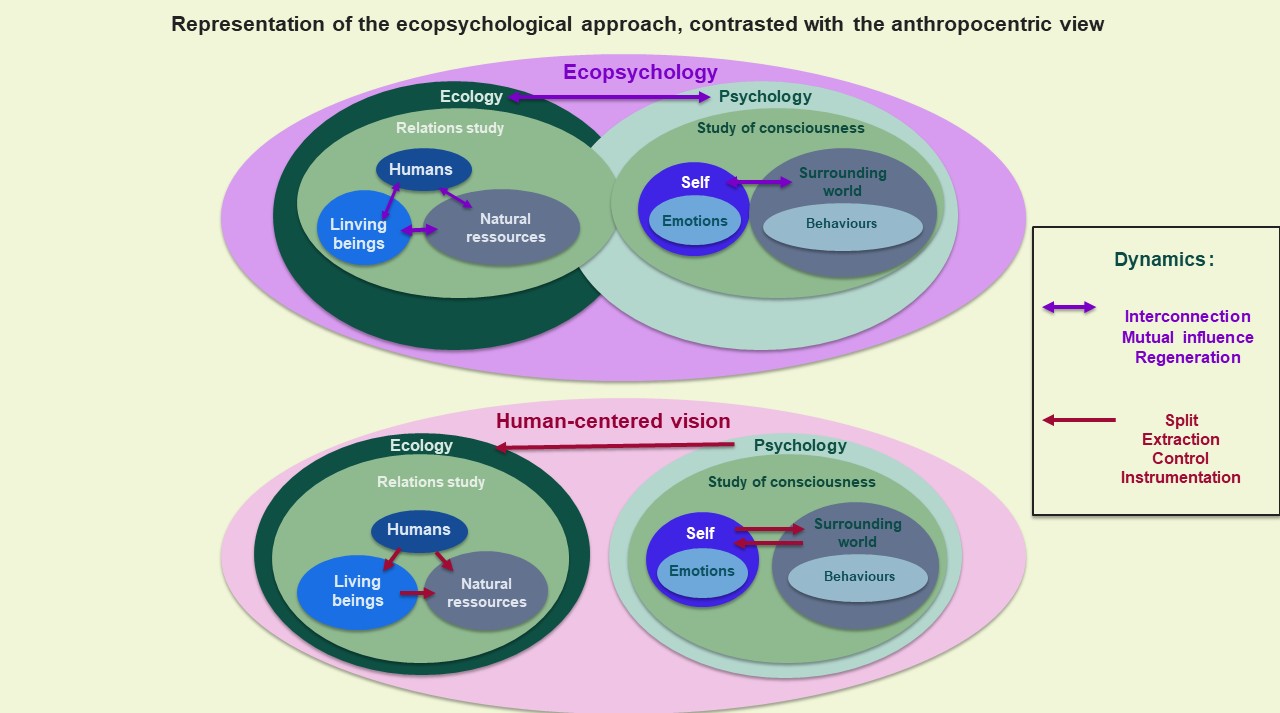
Ecopsychology aims to restore and regenerate the bond between humans and nature by transforming our awareness and practices. This transdisciplinary field, at the intersection of psychology, philosophy, and environmental sciences, is based on a twofold observation: our actions sometimes irreversibly damage ecosystems, revealing a deep disconnection from the living world. Moreover, we tend to perceive nature as a collection of separate entities, when in fact it forms an interdependent whole of which we are a part.
Theodore Roszak formalized ecopsychology in the 1990s, drawing inspiration from numerous Western and non-Western thinkers throughout the centuries. He combines social criticism with spiritual advocacy. One of the starting points is the observation of the destructive behaviour toward the environment exhibited by materialistic societies that lack respect for living beings. Andy Fisher, following the same logic of reconciliation with the Earth, adds a societal dimension to this. The healing of society would require the development of sensory and relational experiences with nature, connecting the body, the environment, and symbolic representations.
Ecopsychology offers a fresh perspective on agroecology. It encourages us to move beyond an objectifying view by emphasizing the relationships between humans and the Earth through a framework of mutual care, rather than an anthropocentric (human-centered) perspective focused solely on the exploitation of services or the extraction of resources. For example, some farmers preserve century-old trees on their land, not for the ecosystem services they provide, but for their aesthetic, symbolic, or emotional value linked to the ancestors who planted them. For this transformation, farmers are led to question their place in the world by acknowledging a transcendent dimension, as well as to reconnect with themselves by integrating their emotions to rethink their choices. This also involves reconnecting with life by recognizing the interrelationships and interdependencies among all beings.Ecopsychology challenges agricultural practices by moving beyond an anthropocentric logic of production and transforming it into a practice of reciprocity.
References to explore
FISHER, Andy, 2002. Radical Ecopsychology: Psychology in the Service of Life. State University of New York Press.
GUÉRIN, Patrick, ROMANENS, Marie, BURDIN, Nadine, EVANS, John et VIDAL, Michel, 2025. Définitions de l’écopsychologie – écopsychologie. [en ligne]. 2025. [Consulté le 28 novembre 2025]. Disponible à l’adresse : https://eco-psychologie.com/definitions-de-l-ecopsychologie/
JAVELLE, Aurélie, 2021. Du « faire avec » au « devenir avec » la nature en système maraîcher : l’émergence d’agricultures sympoiétiques. Tracés. Revue de Sciences humaines. juin 2021. N° 40, pp. 27‑42. https://doi.org/10.4000/traces.12135
REPORTERRE, 2017. L’écopsychologie veut renouer le lien entre les humains et la nature. Reporterre, le média de l’écologie – Indépendant et en accès libre [en ligne]. 7 février 2017. [Consulté le 28 novembre 2025]. Disponible à l’adresse : https://reporterre.net/L-ecopsychologie-veut-renouer-le-lien-entre-les-humains-et-la-nature
ROSZAK, Theodore, GOMES, Mary E., KANNER, Allen D., ISERTE, Morgane et HILLMAN, James, 2023. Écopsychologie : le soin de l’âme et de la Terre. Marseille : Wildproject. Le monde qui vient. ISBN 978-2-38114-052-0.
SVEJCAR Yoan, 2023. Petit traité d’ecopsychologie. Pour une transformation radicale de la société. L’Isle sur la Sorgue : Le Bois d’Orion.
SVEJCAR, Yoan et BOËGEAT, Fanny, 2023. L’écopsychologie, c’est quoi ? Ecopsychologie [en ligne]. 2023. [Consulté le 28 novembre 2025]. Disponible à l’adresse : https://www.eco-psychologie.org/l-%C3%A9copsychologie-c-est-quoi


Do you have an opinion or a question about this definition?
Your email address will not be published.
Required fields are marked with *.